
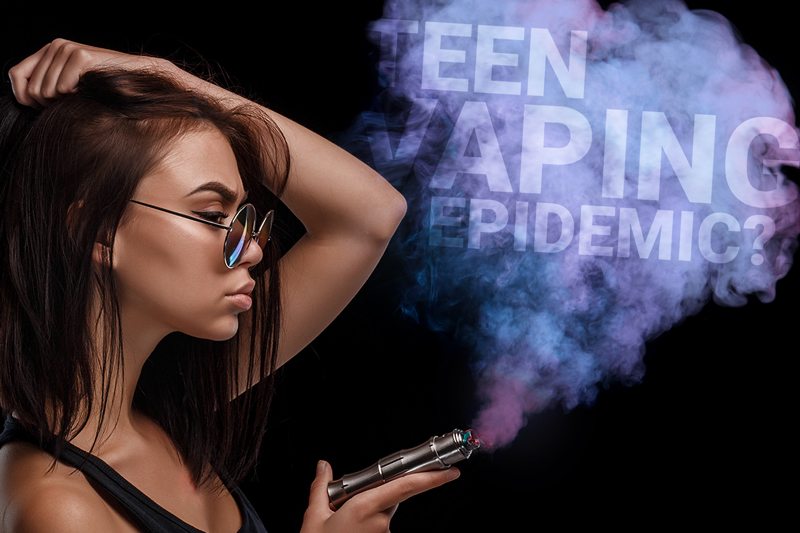
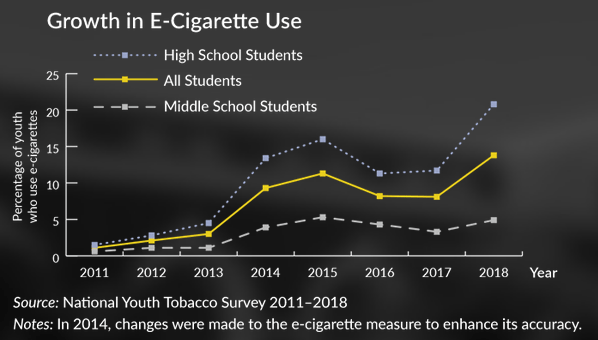
Looking around any public location, it has become commonplace to see youth and young adults vaping. In fact, E-cigarette use within teenagers and young adults has increased at an alarming rate over the past decade. For example, data from the Centers for Disease Control and Prevention and the Food and Drug Administration noted that rates of reported e-cigarette use within the past 30 days rose by more than 75 percent in high-school students and by 50 percent in middle-school students between 2017 and 2018 (U.S. Food and Drug Administration, 2020).
Epidemic Strikes
This has become such an enormous problem that the U.S. Surgeon General Vice Admiral, Jerome M. Adams, issued an advisory naming e-cigarette use an epidemic.In the advisory, the US Surgeon General stated, “The recent surge in e-cigarette use among youth, which has been fueled by new types of e-cigarettes that have recently entered the market, is a cause for great concern. We must take action now to protect the health of our nation’s young people.” (Adams, 2020).

Something must be done to stop the rapid rise of e-cigarette use within our youth. How can we as citizens and responsible adults protect our youth? It is crucial that we lobby to our legislators for implementation of steps to protect our children from these potent, highly addictive nicotine containing products. We can, and should, urge our legislators to implement strategies to reduce e-cigarette usage. This includes strategies such as restricting access to e-cigarettes in the retail setting, limiting flavouring of nicotine containing products, educating youth on the dangers of using these products, and implementing price policies to make it more difficult to obtain. What, if anything, have our local legislators done to help address and reduce this crisis?
Legislation and Policies
As discussed previously in this blog series, many reforms and bills are being passed in the state of Arizona to make it more difficult for youth to obtain nicotine containing products, specifically e-cigarettes in an attempt to address and target this epidemic. Heather Carter continues to be a key player in the development of such bills, creating and sponsoring numerous anti-nicotine movements. Most notably, her efforts on HB 2357 resulted in unanimous passage of this legislation which further classifies vapor products as tobacco products. In doing this, vapor products fall under the Smoke-Free Arizona Act which makes them subject to restrictions on public use, just like cigarettes.

In addition to Senator Carter’s efforts, Arizona Senator Juan Mendez introduced SB 1517 which would impose a 95 percent tax on the wholesale cost of vaping products making it more difficult for youth to afford and purchase vaping products. This met much opposition, particularly from the vaping industry and small business owners. This resulted in the bill failing in the chamber.
Through each anti-vaping bill passed and policy implemented, we are one step closer to addressing and reducing youth usage of e-cigarettes. With luck and massive effort, believe we can stop this epidemic.
References
Adams, J. (2020). Surgeon General’s advisory on e-cigarette use among youth. Retrieved from https://e-cigarettes.surgeongeneral.gov/documents/surgeon-generals-advisory-on-e-cigarette-use-among-youth-2018.pdf
Arizona SB1517 | 2017 | Fifty-third Legislature 1st Regular. (2017). Retrieved from https://legiscan.com/AZ/bill/SB1517/2017
Cullen, K. A., Gentzke, A. S., & Sawdey, M. D. (2019). E-cigarette use among youth in the United States. JAMA, 32(21), 2095-2103.
Sponsor of e-cigarette bill wants vaping products classified as tobacco. (2019, January 9). Retrieved from https://www.azcentral.com/story/news/politics/arizona/2019/01/09/arizona-bill-would-classify-e-cigarettes-tobacco-products-youth-vaping-juul-pod/2515650002/
U.S Food and Drug Administration. (2019, November 18). National youth tobacco survey. Retrieved from https://www.fda.gov/tobacco-products/youth-and-tobacco/youth-tobacco-use-results-national-youth-tobacco-survey
Wang, T. W., Gentzke, A., & Sharapova, S. (2018). Tobacco use among middle and high school students -United States. MMWR Morbidity and Mortality Weekly Report., 67(22), 629-633.
 Vaping health hazards and need policy change
It is a relief that elected Arizona officials are playing an active role in the limitation of vaping access across the state. I hope they continue their efforts with little resistance.
On the federal level, the U.S. Food and Drug Administration (FDA) has imposed regulations on electronic nicotine delivery systems (ENDS). In August of 2016, it became illegal to sell e-cigarettes to minors and retailers were held responsible for requiring age verification with photo ID for those under 27 years of age to purchase a tobacco product (Sharpless, 2019). Since 2016, more than 8,000 warning letters were sent to retailers for sales of ENDS to minors and issues several guidances to inform stakeholders about how certain requirements may apply to vape shops and how to comply with prohibiting free samples of tobacco products (Sharpless, 2019). The FDA also created the Youth Tobacco Prevention Plan (YTPP), focusing on three important areas to prevent youth use of e-cigarettes: curtailing marketing toward youth, preventing youth access to tobacco products, and educating teens and their families about the dangers of tobacco. YTPP involves frequent retailer inspections and surveillance of manufacturers and retailers who sell and advertise tobacco products in the U.S. (Sharpless, 2019).
Perhaps with continued diligence, lives will be saved with the decreased use of vaping products.
Reference
Sharpless, N. (2019). How FDA is regulating e-cigarettes. Retrieved from https://www.fda.gov/news-events/fda-voices-perspectives-fda-leadership-and-experts/how-fda-regulating-e-cigarettes
LikeLike
James,
The layout of this post is interesting, and easy to read. You’ve used several interesting graphics; I do not know where you found the smoke lungs at the top. I found your blog informative with enough detail and story to paint a good picture.
You speak about the work of Senator Carter and vaping. I had the pleasure to meet Senator Carter and be present for her press conference in November regarding teen vaping and her bill proposal to increase legal age to 21 and to treat vaping like a tobacco product. While there I met a supporter/activist who shared with me about the “lax” laws in Arizona about selling tobacco to minors in relation to fines and prosecution. Though the legal age to purchase tobacco products may be increased, without adequate monitoring and enforcement of underage sales minors will still have access to tobacco products. In February 12News reported “Undercover teens bust hundreds of Arizona stores selling vape products to minors”, 457 retailers in 2019 (Dana & Wilcox, 2020). Currently there is no change in the fine or repercussions to the store for subsequent offenses, and some retailers have be caught selling to minors more than 5 times (Dana & Wilcox, 2020).
Currently there is little incentive for and offender to not be a repeat offender. If the fines increased with each offence, if there were other penalties like the loss of ability to sell tobacco products or incarceration retailors would be incentivized to be diligent and compliant in the sale of tobacco products. Improved support from the public sector is needed in the regulation, monitoring, and enforcement of laws for underage tobacco sales.
What is your opinion about current state laws in relation of sale of tobacco to minors?
Reference
Dana, J. & Wilcox, K. (2020). Undercover teens bust hundreds of Arizona stores selling vape products to minors [webpage]. Retrieved from: https://www.12news.com/article/news/investigations/undercover-teens-bust-hundreds-of-arizona-stores-selling-vape-products-to-minors/75-d69f38ce-e02c-4a83-9945-b1487f26d648
LikeLike