Week 13

The recommendation to prevent youth vaping and tobacco usage.

Safety Signs, Safety Tags and Safety Labels by Accuform Signs

A good solution to the vaping epidemic in Arizona would call for the removal of flavouring from tobacco products. This would include all vaping products that contain flavouring as well as menthol flavouring from all other tobacco products. though the Food and drug administration has already band some flavouring included in this legislation would be the inclusion of all flavouring to included menthol. Legislation would also call for strong non-removable wording regarding the danger of vaping products directly on all vaping devices and accessories not just that products contain nicotine but also talk about the dangers of nicotine use.

Vape ban: DIY vape juice mixing is on the rise - Vox

The cost of vaping prevention

Arizona legislation spends far less then the Center for Disease Control best practice spending recommended on tobacco prevention and cessation. The Center for Disease Control recommends states spend around $64,400,000 a year on tobacco prevention and cessation funding. Arizona in fiscal year 2020 spent 16,990,40 dollars for tobacco control programs. this equates to a barely over 29% of what the Center for Disease Control recommends.

The American Lung Association calls for action of Arizona’s elected officials to increase taxes on tobacco and vaping products by $1.00 per pack. They have also recommended Arizona legislature to develop and charge for licensing for businesses that sell tobacco or vaping products.

Current funding for tobacco and vaping prevention in Arizona is massively underfunded. This is why simple legislative change like forcing companies to remove all flavouring from vaping products and mandating large non-removable warning regarding the hazards of vaping products would need very little financial revenue from the state as only a small change in monitoring would need to be increased to include checking for compliance.

The sustainability of forcing tobacco and vaping companies to change is very likely as the state would force most of the work to come from the tobacco and vaping companies.

In the end simple legislative rulings would positively impact Arizona Teens regarding the allure of vaping products that are being marketed to them. If a message in on every vaping device regarding the hazards of vaping consumers of these products will be able to make a more informed decision on their health and dangers.

These legislative changes would really only financially impact the companies that produce these products. Due to the already limited funding that is going on with prevention measures in Arizona this would be ideal. Who ever Arizona could also raise taxes per recommendations of both the American Lung Association as well as the Center for Disease Control.

References

American Lung Association, (2020). Did your state make the grade? Retrieved from https://www.lung.org/research/sotc/state-grades/arizona

Lovelace, B., (2020). The FDA bans most fruit- and mint-flavored nicotine vaping products to curb teen use. Retrieved from https://www.cnbc.com/2020/01/02/fda-issues-ban-on-some-flavored-vaping-products.html

King, B., Pechacek, T., Mariolis, P., & Centers for Disease Control Prevention . Office on Smoking Health. (2014). Best practices for comprehensive tobacco control programs–2014. (2014 ed.).

Week 11

The Technology of Addiction

No one in America today goes anywhere without their electronic leash. I am talking about their cell phone. On everyone’s cell phone, there are apps. Some apps are paid for, some apps are free, but all of them are tracking you in some way. If you think its not happening to you, or that it doesn’t matter, I would suggest you read up on privacy and the harm that can be done when this information is used for nefarious purposes. Studies have shown that google tracks your location around 340 times a day. Google is a company with governments constantly regulating and monitoring their data collection. So what does this mean for apps and companies not being so closely scrutinized.?

congress confronts Facebook about data collection

If you use Facebook, the biggest offender of data violation in the eyes of most security organizations, they are consistently tracking everything you do, say, and use. Even though you may not have a Facebook account, if someone puts any information about you on Facebook, Facebook creates a file on you and sells that information when possible.

All this information collection, so what?

All this information can be bought and sold to anyone interested enough to want your information. Anything you post or do while using the app is stored. If you think Facebook messenger is private….it’s not. If you think your physical location is private…it’s not. If you think an of the image you have shared or posted on Facebook is secured…it’s not. Who you are, who you interact with, and what you are interested in is for sale at any time to the highest bidder.

Big Tobaccos data collection

iQOS Navy Tobacco Heating Technology System Set Not use ...

Philip Morris and other tobacco companies are now starting to utilize technology to better market tobacco. Modern vaping products are getting more technologically advanced. They utilize apps on your phone or computer to deliver tobacco at different rates and amounts. But much like Facebook and just about every other app you have on your phone, they are tracking you.

The worst organization that can track you, tobacco companies, are starting. It is likely that tobacco companies will start tracking the number of puffs and the amount of liquid an individual uses. They will likely also start tracking the location and setting of use in addition to the individual using the product.

This information will then be used to find better ways to market and sell tobacco products and likely used to find better ways to sell to their new best possible target market. Sadly enough, this target market is our youth.

Building a youth market base that will likely last the lifetime off that base as soon as possible is likely the goal. When tobacco companies have more data regarding how to market to youth, they will use it with great success as has been seen with the current epidemic of youth vaping.

If you are not paying for it, you’re not the customer; you’re the product being sold

Andrew Lewis

So what can be done?

Going beyond apps specific to tobacco, individuals need to be aware that if something is free, developers are absolutely tracking everything they can about you and selling it. In regards to big tobacco, we as citizens need to push our legislation to restrict any data collection done by tobacco organizations, specifically information regarding our youth.

In an interview with a local southern Arizona school official, he also recommended for parents to become more involved and provide more support to the tobacco prevention legislation and education that is being provided. He also mentioned that we need to help provide more funding to prevention based education, especially for the youth of Arizona.

As a healthcare provider, I can not emphasize more about how an ounce of prevention is much better than pounds of treatment. If we could help the youth of Southern Arizona become more aware and undo the culture change big tobacco has made regarding vaping and the harm associated with vaping and tobacco, we would save the youth of America from the folly so many smokers suffer from today.

References

Infobase, film distributor, & PBS. (2018). The Facebook Dilemma : Part 1 (The Facebook Dilemma).

CBS News (2018). Mark Zuckerberg pressed on Facebook’s collection of personal data . https://www.youtube.com/watch?v=WHszEcin5uE

Simon, M. (2018). Google Privacy Checkup FAQ: How to limit tracking and still use the apps you love. PC World (Online), 87-93.

Lasseter, T., Wilson, D., Wilson, T., & Bansal, B. (2018). Philip Morris device knows a lot about your smoking habit. Retrieved from https://www.reuters.com/investigates/special-report/tobacco-iqos-device/.

Week 9

Tobacco companies Innovation to push an new demographic of users.

Vaping in itself is an innovation of technology. Tobacco companies had to innovate to move their product into a new generation of users. They have done this by focusing on products and innovating to market to youth. They make products to look sexy. Vaping companies make products and reviews to “make mods sexy” and “hot as hell”. What these companies are doing is making products designed to target our youth.

innovation from tobacco to vaping with the use of computer technology

This is reinforced after an interview with The Vice President of Academics of a local southern Arizona chart school and up until mid-2019 a principal for the public school sector in Southern Arizona. In the interview, The VP of Academics stated that vaping companies are absolution marketing to youth. Kids think its cool big clouds and flavoring. We also talked about the design and makeup of vaping devices to “mods” like lights and colors as a marketing tool towards the youth.

When asked about one innovation regarding vaping that they would like to see in the future. The educator stated they would like to see some kind of bigger push to educate the youth of Arizona about the dangers of vaping, sex, and illicit drug use.

My self as a healthcare professional could not agree more with these needs. The Arizona youth get limited access to this kind of information. Young Americans need good information to make the best decision regarding these extremely important subjects that they are dealing with in their lives.

Finally, the blog asked the educator how they would see this innovation become sustainable. the educator reported that they would like to see tax money from things like vaping, tobacco, and legal marijuana go directly to these kinds of education programs.

As a healthcare provider, I agree The use of tax money coming from these negative lifestyle choices should be what funds the prevention of them. Colorado made 247 million dollars in marijuana tax licensing and fees. Why can’t Arizona do the same for vaping and tobacco? A tax to help stop this epidemic before it gets any worse would be life-changing for so many of Arizona’s youth. Currently, tax money is spent on tobacco is going to programs but also goes to fund other state programs.

Colorado Marijuana tax “cash” fund budget

Critics of this kind of state taxing feel, without direct laws stating exactly how taxes are to be spent, states become overly reliant on these kinds of taxing and divert money from their intended goals to other projects. Tax law needs to state that spending is specifically on the intended use of tax money. An example would be, taxes on tobacco only go to funding the taxing process of tobacco/vaping and the rest going to prevention education. This would mean the more users spend on vaping/tobacco the more money would go to stopping its use. As vaping/tobacco use decreases so does funding. It would be a self-balancing system and that would be one great innovation.

References

Atkins, C. (2006). Arizona is Hooked on Cigarette Tax Revenue. Retrived from https://taxfoundation.org/arizona-hooked-cigarette-tax-revenue

Marie, A. (2018). Where Does All The Marijuana Money Go? Colorado’s Pot Taxes, Explained. Colorado Public Radio News. Retried from https://www.cpr.org/2018/10/22/where-does-all-the-marijuana-money-go-colorados-pot-taxes-explained/

Melero, A. (2018). 5 innovations that might change vaping in 2018. The Vaping Times. retrieved from http://www.thevapingtimes.com/5-innovations-that-might-change-vaping-in-2018/

Week 7: An Epidemic and Intervention

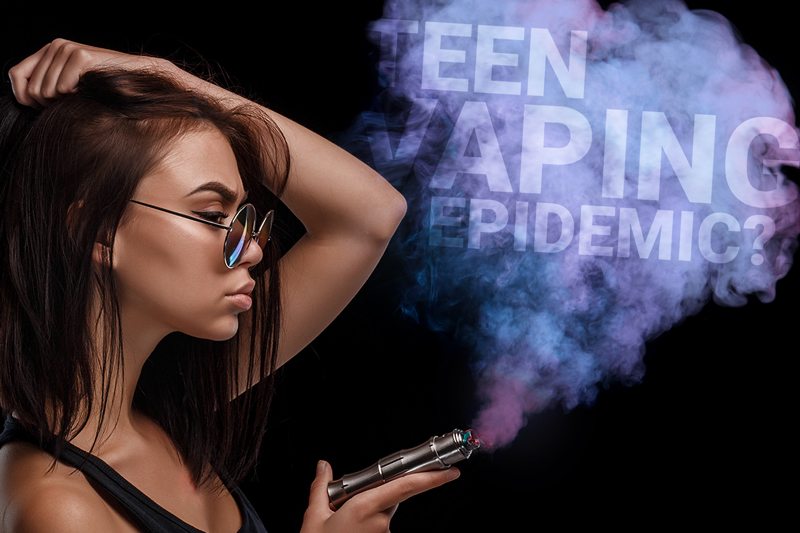
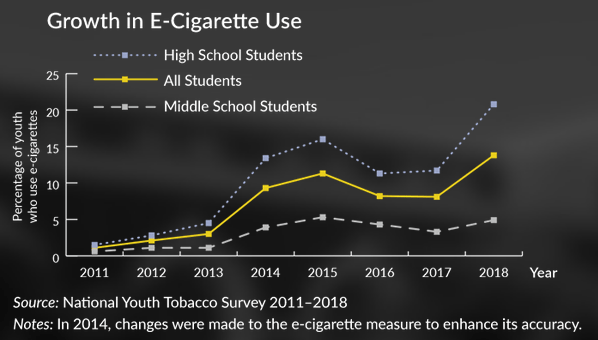
Looking around any public location, it has become commonplace to see youth and young adults vaping. In fact, E-cigarette use within teenagers and young adults has increased at an alarming rate over the past decade. For example, data from the Centers for Disease Control and Prevention and the Food and Drug Administration noted that rates of reported e-cigarette use within the past 30 days rose by more than 75 percent in high-school students and by 50 percent in middle-school students between 2017 and 2018 (U.S. Food and Drug Administration, 2020).

Here, the alarming increase of E-cigarette use is demonstrated

Epidemic Strikes

This has become such an enormous problem that the U.S. Surgeon General Vice Admiral, Jerome M. Adams, issued an advisory naming e-cigarette use an epidemic.In the advisory, the US Surgeon General stated, “The recent surge in e-cigarette use among youth, which has been fueled by new types of e-cigarettes that have recently entered the market, is a cause for great concern. We must take action now to protect the health of our nation’s young people.” (Adams, 2020).

Jerome Adams, current US Surgeon General, seen giving statement at press conference.

Something must be done to stop the rapid rise of e-cigarette use within our youth. How can we as citizens and responsible adults protect our youth? It is crucial that we lobby to our legislators for implementation of steps to protect our children from these potent, highly addictive nicotine containing products. We can, and should, urge our legislators to implement strategies to reduce e-cigarette usage. This includes strategies such as restricting access to e-cigarettes in the retail setting, limiting flavouring of nicotine containing products, educating youth on the dangers of using these products, and implementing price policies to make it more difficult to obtain. What, if anything, have our local legislators done to help address and reduce this crisis?

Legislation and Policies

As discussed previously in this blog series, many reforms and bills are being passed in the state of Arizona to make it more difficult for youth to obtain nicotine containing products, specifically e-cigarettes in an attempt to address and target this epidemic. Heather Carter continues to be a key player in the development of such bills, creating and sponsoring numerous anti-nicotine movements. Most notably, her efforts on HB 2357 resulted in unanimous passage of this legislation which further classifies vapor products as tobacco products. In doing this, vapor products fall under the Smoke-Free Arizona Act which makes them subject to restrictions on public use, just like cigarettes.

In addition to Senator Carter’s efforts, Arizona Senator Juan Mendez introduced SB 1517 which would impose a 95 percent tax on the wholesale cost of vaping products making it more difficult for youth to afford and purchase vaping products. This met much opposition, particularly from the vaping industry and small business owners. This resulted in the bill failing in the chamber.

Through each anti-vaping bill passed and policy implemented, we are one step closer to addressing and reducing youth usage of e-cigarettes. With luck and massive effort, believe we can stop this epidemic.

References

Adams, J. (2020). Surgeon General’s advisory on e-cigarette use among youth. Retrieved from https://e-cigarettes.surgeongeneral.gov/documents/surgeon-generals-advisory-on-e-cigarette-use-among-youth-2018.pdf

Arizona SB1517 | 2017 | Fifty-third Legislature 1st Regular. (2017). Retrieved from https://legiscan.com/AZ/bill/SB1517/2017

Cullen, K. A., Gentzke, A. S., & Sawdey, M. D. (2019). E-cigarette use among youth in the United States. JAMA, 32(21), 2095-2103.

Sponsor of e-cigarette bill wants vaping products classified as tobacco. (2019, January 9). Retrieved from https://www.azcentral.com/story/news/politics/arizona/2019/01/09/arizona-bill-would-classify-e-cigarettes-tobacco-products-youth-vaping-juul-pod/2515650002/

U.S Food and Drug Administration. (2019, November 18). National youth tobacco survey. Retrieved from https://www.fda.gov/tobacco-products/youth-and-tobacco/youth-tobacco-use-results-national-youth-tobacco-survey

Wang, T. W., Gentzke, A., & Sharapova, S. (2018). Tobacco use among middle and high school students -United States. MMWR Morbidity and Mortality Weekly Report., 67(22), 629-633.

Week 5 History, Players, and Regulation.

“A custom loathsome to the eye, hateful to the nose, harmful to the brain, dangerous to the lungs and in the black stinking fume there of, resembling the horrible Stygian smoke of the pit that is bottomless.”

King James of England regarding the use of tobacco, 1604.

The regulation and use of tobacco has a long history of opponents going as far back as the 17th century. King James of England outright prohibited its use throughout the English empire. Other countries at the time did the same, to include Japan, Russia, Naples, China Sweden, and Sicily to name a few.

Prohibition and Tobacco, American Statutory Regulation Begins.

In the United States legislation regarding tobacco originally comes from the prohibition movement of the 1800s. The movement viewed tobacco as dangerous to the youth, pregnant woman, and saw links to overall health problems.

By the 1890s most states had laws prohibiting the sale use and distribution of tobacco with focuses on youth restrictions of the substance.

World War 1 changes everything

Marketing of tobacco focused on the American patriot helped push tobacco sales and organizations like the American red cross and US government sending cigarettes to the US soldier overseas and someone questioning these actions was seen as unpatriotic. this shift in paradigm due to tobacco lobbyists helped the tobacco companies take hold of the American way of life. This lobbying continues to today and has had 100 years to refine itself.

Today’s Players and Regulations.

In 2009 the Food and Drug Administration (FDA) in the United States began regulation of tobacco products with the Family smoking prevention and tobacco control act (FSPTCA). Before this time most regulations were from the state level and some congregational level regulation. Since (FSPTCA) inception the FDA has developed many regulations and advisory committees regarding the health impacts of tobacco. most recently the FDA has raised the minimum age for tobacco use to include E-cigarettes to 21.

Arizona’s Local players

Sent. Heather Carter R-Cave creek has been one of the major players in the prevention of the youth vaping problem. She has pushed for changing regulations in Arizona that protect vaping as somehow different from tobacco. Sadly last year’s SB 1009 that would make the sale of all vaping products fall under the same laws as tobacco products in the state and pushed for stronger youth prevention of vaping was shut down last year. All this while the tobacco industry pushes for legislation that would make it harder for lawmakers in Arizona to regulate the sale of vaping and E-cigarette products. This has not stopped the Senator as she is pushing again for stronger vaping legislation to protect teens from the epidemic.

If history has taught us anything is that without understanding the players and the rules they play by we can never change. Big tobacco is shifting to vaping and they are using the same game plane they have for 100 years. IF we as local Arizonians don’t push our legislation do something to stop them they will again be making the laws that have been killing us and our children again.

References

Alston, L., Dupré, R., & Nonnenmacher, T. (2002). Social reformers and regulation: The prohibition of cigarettes in the United States and Canada. Explorations in Economic History, 39(4), 425-445.

Giovanni, J.(1992, Augest),Come to Cancer Country; USA; Focus. The Times London

Sobel, R. (1978). They satisfy : The cigarette in American life (1st ed.). New York: Anchor Press/Doubleday.

Oxford, A. (2019, November 19). Some Arizona lawmakers want higher smoking age, tougher rules on vaping. https://www.azcentral.com/story/news/politics/arizona/2019/11/19/some-arizona-legislators-want-tougher-vaping-laws-higher-smoking-age/4237598002/

Warfield, F.(1930). Lost cause, A Portrait of Lucy Page Gaston, Outlook and Independent,244–247, 275–276

Week 3

Health policy ethics got a little muddy

We need to educate ourselves regarding important health care policies in order to make appropriate health care decision. With this education, we also need to empower ourselves to become pennants of government to impact the changes we want and need to see for ourselves. Otherwise, the ethics we stand for will not be enforced to their fullest potential as you will see.

How does the ethics of healthcare mix with policy and policy makers’ ethical obligation to protect the health and well being of its people? Unfortunately, what is ethically right does not always win, at least not fully. This is why we as people of the world need to do more.

The American Academy of Pediatrics (AAP) has a policy statement on E-cigarettes. They very obviously do not support them. The AAP had formally said in their policy letter, on 1/28/2019 over one year ago, that nicotine is addictive, has lasting damaging impact on young brains, and other adverse health outcomes. They openly stated that E-cigarettes need to be regulated to stop young children,teens, and young adults from accessing them. Further more, they make the claim that there is a youth demand created by characterized flavors and other advertising to youth should be banned. The AAP makes further claims for legislative change in their policy letter that can been found via the link below.

https://www.aap.org/en-us/about-the-aap/aap-press-room/Pages/AAP-Policy-Statement-E-Cigarettes-Need-Stronger-Regulations-to-Prevent-Youth-Access-and-Use.aspx

The AAP took a stand on Vaping relatively quickly. The AAP saw the dangers that vaping could have on the American youth and as an organization with the mission “to attain optimal physical, mental, and social health and well-being for all infants, children, adolescents and young adults,” they have created an ethical obligation to do so. The AAP seeing that vaping was being marketed to youth and knowing the health hazards of nicotine next created a policy statement. This statement asked government organizations to create their own policy regarding this problem and you know what the government did…..kind of.

What did not happen was an all out ban on flavoured E-cigarettes. Unfortunately, government lobbying by the vaping and tobacco industry increased from the 2018 total of 23 million to 20 million by first three quarters of 2019 per the New York Times. This extreme lobbying created a loop hole where only refillable flavoured E-cigarettes are banned. Disposable flavoured E-cigarettes remain on the market and are fast become the vaping tool of choice for American teens.

This is an ethical problem in America. There is a responsibility not just for healthcare workers but for everyone to protect our youth. Yet lobbying by tobacco and vaping business has somehow superseded this.

I understand there is a need for businesses and organization to lobby. We all have a right to talk to our elected officials, but when we put the future of America at risk, how can we as Americans feel our government officials’ ethics line up with ours? Is this not the reason we put them in office? What is our ethical obligation to fix this error?

References

AAP facts.(2020). Retrieved from https://www.aap.org/en-us/about-the-aap/aap-facts/Pages/AAP-Facts.aspx

ABC News.(2020). White House moves to ban certain e-cigaretts . Retrieved from https://www.youtube.com/watch?v=vLUQ6xGy-vI

Goodnough, A., Haberman, M. & Kaplan, S. (2020). With Partial Flavor Ban, Trump Splits the Difference on Vaping Retrieved form https://www.nytimes.com/2020/01/02/health/flavor-ban-e-cigarettes.html?searchResultPosition=2

Kaplin, S.(2020). Teens Find a Big Loophole in the New Flavoured Vaping Ban. Retrieved from https://www.nytimes.com/2020/01/31/health/vaping-flavors-disposable.html

Longest, B.B. Jr. (2010). Health policy making in the United States (5th ed.). Chicago,
IL: Health Administration Press.

Patton R.M., Zalon, M.L., & Ludwick, R. (2015). Nurses making policy: From bedside to boardroom. New York: Springer.

Week 1

Why is there a blog about vaping?

I started smoking cigarettes at the age of 13. I was young and had plenty of support and education to know better. No one in my family used tobacco. In fact, I had multiple talks with my parents about avoiding tobacco, and plenty of education in school. Unfortunately, as a young man I bought into the advertising that tobacco manufactures sold me. I wanted to be cool. I wanted to be wild and free. I wanted to show the world I was capable of being my own adult. It took me about 12 years before I realized how terrible this choice was for me. Only until I found my self deployed in the military with limited access to cigarettes did I even try to quit. Since that time, I have been tobacco free for well over 10 years. I have grown up, gotten an education in health care, and am working on my doctorate. In returning to school I have noted a marked increase in the use of vaping among young adults and under-aged teens. I have also seen an increase in the use of advertising targeting youth with vaping specific products as well as the increased presence of “vape shops” in my community. This concerns me as a health professional. Even with multiple new policies being created including an increase of the legal age required to purchase vaping supplies in Arizona, more of our youth are starting to vape and use tobacco. There is a new target for tobacco and it’s our youth.

This shift in perspective of the hazards related to e-cigarette use is alarming. I personally know how easy it is to start using tobacco. Things like flavored and colored “E-Juice” and social media influences marketing light up and designer vaporizers continue to push these products onto a new, younger generation.

This YouTube video sponsored by an e-cigarette company highlights the targeted marketing that is being focused on young Americans today. the above videos push is towards youth and uses bright colors and techno music. It also describes vaping as a sport/hobby.

The National Institute of Health’s (NIH) National Institute of Drug Abuse (NIDA) found that teens are being exposed to advertising regarding E-cigarettes at a disproportionate rate

NIH also has statistics regarding teens who use E-cigarettes and their likelihood to start smoking compared to non-users. The data shows a much higher rate of use with e-cigarettes. Data on what teens think are is their E-juice are also listed. It’s important to know that there is no requirement to list what is actually in the product.

There is currently some traction in my community. As of January 1, 2020, Arizona legislation increased the legal age of tobacco use to 21 years of age in Tucson. There are also representatives in the local community seeking to improve the vaping and tobacco situation in our community.

Heather Carter, legislative senator for District 15, has spear-headed several bills regarding tobacco and is looking to make vaping advertisements to be governed by the same laws as tobacco.

References

Fischer, H. (2019). Proposed law would regulate vaping products, raise legal age to use them in Arizona. Retrieved from https://tucson.com/news/local/proposed-law-would-regulate-vaping-products-raise-legal-age-to/article_090af754-ef07-5c89-8e2f-72e7fad723b3.html

Lawrence, A. [vAustinL]. (2019, January 20). Best Colored Vape Tricks . Retrieved from https://www.youtube.com/watch?v=EwhN7EsVNSo

National institute of Health. (2016). Teens and E-cigarettes. Retrieved from https://www.drugabuse.gov/related-topics/trends-statistics/infographics/teens-e-cigarettes

Sayers, J. (2019). Tucson tobacco ordinance could precede renewed push for statewide law. Retrieved from https://tucson.com/news/local/govt-and-politics/tucson-tobacco-ordinance-could-precede-renewed-push-for-statewide-law/article_1b4fb555-318f-5ab0-9878-da03022219f1.html

Senate Members (2020). Senate Member Heather Carter. [JPG]. Retrieved from https://www.azleg.gov/senate-member/?legislature=54&legislator=1931